Professional Wheelchair & Mobility Aids Manufacturer | Feiyang Medical Phone: +86-13809226584 E-mail: fymed@vip.163.com

Author: Site Editor Publish Time: 2026-08-30 Origin: Site
Selecting the right commode chair is never a standard purchase. It involves mitigating serious risks surrounding daily hygiene routines. Caregivers face daily challenges during patient transfers. Poorly designed equipment drastically increases infection risks. Whether you buy for a large healthcare facility or a private home environment, your decision matters deeply. You must move far beyond basic product descriptions. You need to evaluate structural integrity carefully. You must assess environmental resistance. Vendor reliability also plays a crucial role in long-term satisfaction.
This guide gives you a clear, objective framework. You will learn how to analyze specifications accurately. We show you how to match configurations to patient acuity. You will also discover how to vet suppliers thoroughly. Following these steps ensures a compliant, durable, long-term investment. Keep reading to protect patient safety. You will learn to navigate complex equipment choices effortlessly.
You must clearly define the primary function first. Will you use the unit strictly as a bedside toilet? Will it serve as a dedicated shower chair? Perhaps you need a dual-purpose transit chair. A transit chair moves patients directly over standard bathroom toilets. Each scenario demands distinct design features. A bedside-only model needs a large, easily removable pail. A shower chair requires maximum water resistance. A transit chair demands high maneuverability. Understanding these roles prevents poor purchasing decisions.
Next, you must measure environmental constraints carefully. Bathrooms often feature tight spaces. Doorframe widths vary significantly in older buildings. You must know these dimensions before buying. Toilet bowl heights also differ across facilities. You need adequate clearance to roll the chair over existing fixtures safely. Ignoring these details causes immediate equipment abandonment.
Steps to Measure Your Environment:
You also need to analyze patient mobility levels. Assess weight-bearing capacity accurately. Evaluate upper body strength. Determine the level of caregiver assistance required for lateral transfers. Independent patients might prefer self-propelled models. Heavily dependent patients require caregiver-propelled models. Matching mobility levels to the chair prevents accidental falls. It also minimizes caregiver strain during daily routines.
Common Mistake: Many buyers only measure the doorframe width. They forget to account for baseboards or the inward swing of bathroom doors. Always measure the tightest possible bottleneck in the patient's daily route.
Weight capacity and frame durability demand your immediate attention. Standard models typically support up to 250 to 300 lbs. Bariatric models require reinforced steel framing. You must verify static versus dynamic load testing. Static load refers to a stationary patient. Dynamic load accounts for movement. Patients shift their weight constantly. A chair must withstand sudden dynamic forces safely. Weak frames bend under dynamic stress. You must insist on rigorous load verification.
Material selection dictates corrosion resistance. You primarily choose between aluminum and coated steel. Aluminum remains lightweight and rust-resistant. It serves as the ideal material for wet environments. Coated steel provides a higher weight capacity. However, it requires rigorous coating inspection. Scratches expose the steel beneath. Oxidation begins almost immediately in humid bathrooms. You must monitor steel frames closely over time.
Material Comparison Chart
| Material Type | Primary Benefit | Ideal Environment | Maintenance Need |
|---|---|---|---|
| Aluminum | Lightweight, rust-resistant | Showers, wet rooms | Low maintenance |
| Coated Steel | High weight capacity | Bedside, dry rooms | Frequent scratch inspection |
Seating and hygiene dimensions require careful scrutiny. You must review commode wheelchair specifications regarding seat width and depth. The shape of the commode opening also matters. Oval openings generally prevent urine spills better than round ones. Ensure caregivers can remove the pail easily. Rear or top removal options exist. The removal process should never disturb the seated patient. This preserves patient dignity during hygiene routines.
Caster and wheel configurations influence stability heavily. Five-inch castors remain standard for indoor maneuverability. They roll smoothly over flat surfaces. However, you must require dual-locking castors. A dual-locking mechanism secures both the roll and the swivel action. This provides absolute stability during transfers. Single-locking castors allow the chair to pivot unpredictably. This endangers both the patient and the caregiver.
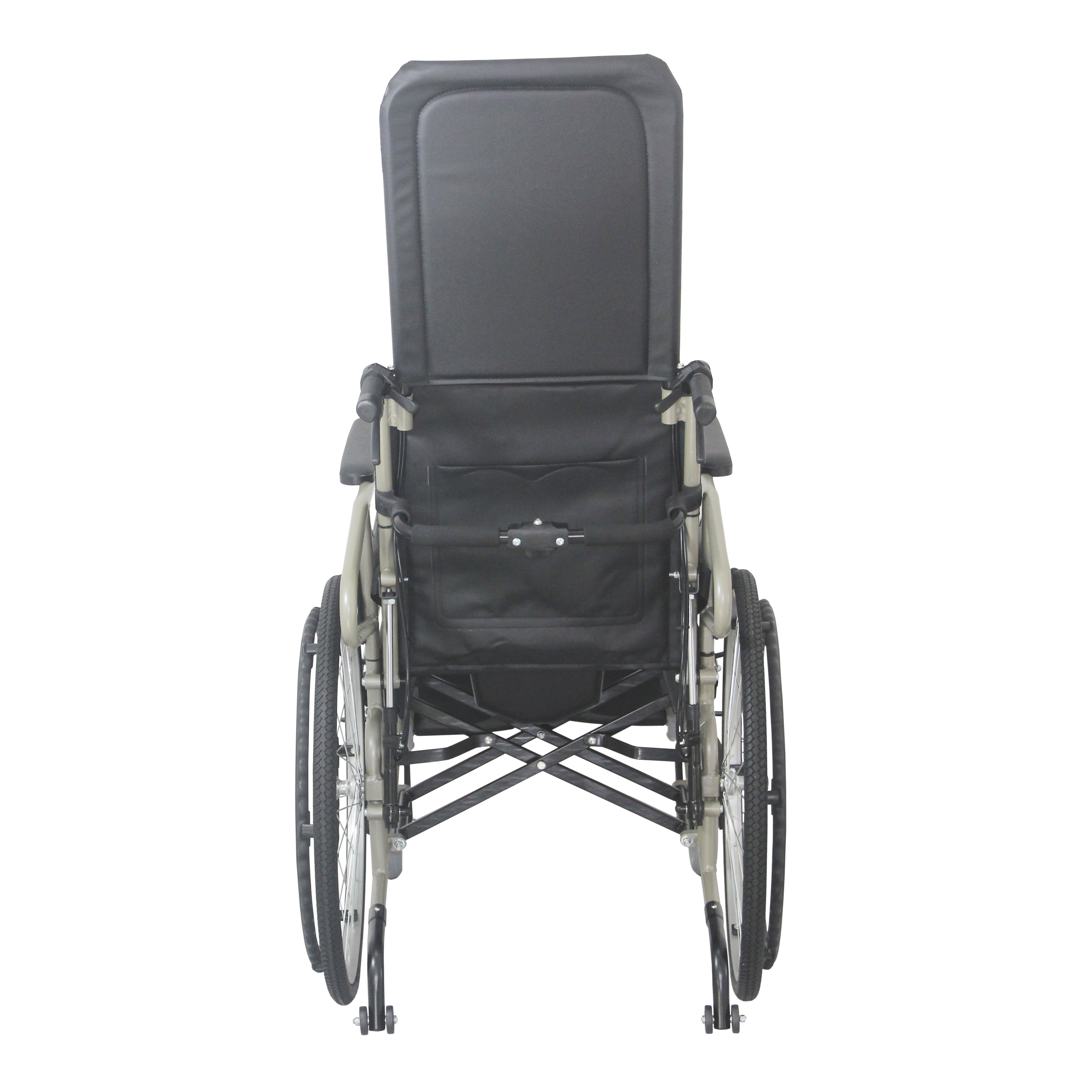
Some patients face severe neurological or physical deficits. Standard models fail these individuals completely. You must evaluate specialized configurations for complex needs. Trunk support and postural alignment become critical factors. Patients lacking core stability risk falling forward. They cannot maintain an upright posture independently. A standard backrest proves entirely insufficient here.
A specialized folding aluminum high back manual commode provides necessary head and neck support. It reduces the risk of dangerous forward falls during transit. It also keeps the patient stable during bathing. High backrests distribute pressure more evenly. They reduce fatigue for patients who sit for extended periods. You protect vulnerable patients by choosing adequate postural support.
Portability and storage features matter for many facilities. Foldable frames are critical for home health agencies. Multi-room facilities also benefit from compact storage. You must assess the folding mechanism carefully. Look for dangerous pinch points. Examine the frame for structural weak spots. Repeated folding stresses the joints over time. A robust hinge system prevents premature equipment failure. You want a chair easy to collapse but rigid when deployed.
Recline and tilt-in-space mechanisms serve highly specific purposes. Medical professionals require them for severe pressure redistribution. They also enable safer hair-washing routines. Tilt-in-space shifts the entire seat angle backward. It maintains the hip-to-knee angle precisely. This prevents shear forces against the skin. Recline mechanisms only tilt the backrest. These features increase the overall footprint significantly. They also raise the purchase price. However, they remain indispensable for high-acuity patients.
Transfer safety features remain entirely non-negotiable. Caregivers perform lateral transfers multiple times daily. Drop-down padded armrests facilitate these movements seamlessly. They allow patients to slide onto the seat laterally. Detachable, swing-away footrests also play a massive role. They clear the pathway completely during standing transfers. This creates a zero-clearance environment. It minimizes trip hazards instantly. You must prioritize these specific mechanical functions.
Infection control protocols demand strict attention. Hospitals and clinics fight pathogens relentlessly. Home care environments face similar challenges. Upholstery must meet rigorous medical standards. It must remain non-porous and anti-microbial. Seamlessly sealed cushions prevent bodily fluids from penetrating the foam. Fluid ingress destroys cushions and harbors dangerous bacteria.
Infection Control Checklist:
You must mitigate hidden implementation risks actively. Caregiver strain represents a massive workplace liability. Heavy, non-ergonomic chairs increase injury risks significantly. Caregivers struggle to push heavy steel frames over carpets. They risk back injuries while manipulating awkward footrests. An overly heavy commode wheelchair frustrates staff quickly. You protect your workforce by selecting ergonomic, lightweight designs.
Incompatibility poses another major implementation risk. Purchasing without verifying measurements causes immediate failure. You must check the floor-to-seat height carefully. Compare it against existing beds or toilets. A mismatched height forces caregivers to lift patients upward during transfers. This violates safe patient handling guidelines completely. Measure twice to guarantee seamless compatibility across all transfer points.
You cannot buy medical equipment from unverified sources. Regulatory compliance serves as your first vetting metric. Ensure the chosen commode wheelchair supplier holds necessary regional certifications. Look for ISO 13485 compliance. Verify FDA Class I or II registration. Check for CE marking if operating in Europe. These credentials prove the manufacturer follows strict quality management systems. They guarantee a baseline of safety and efficacy.
Lifecycle support determines long-term equipment viability. Parts wear out eventually. Casters degrade. Pails crack. Armpads split. A trustworthy supplier provides clear service level agreements (SLAs) on replacement parts. Avoid vendors refusing to stock modular replacements. You should never replace an entire chair just because one castor fails. Predictable parts availability keeps your fleet operational. It prevents frustrating downtime in clinical settings.
Warranty transparency reveals true vendor confidence. Scrutinize the warranty breakdown deeply. Do not accept vague guarantees. Standard industry benchmarks include a lifetime or 5-year warranty on the structural frame. Wear-and-tear components usually carry a 6 to 12-month warranty. These include cushions, wheels, and grips. Read the fine print carefully. Look for hidden clauses regarding environmental damage. A strong warranty protects your capital expenditure.
Procurement scalability matters heavily for B2B buyers. You might outfit an entire hospital wing. You might stock a regional distribution center. Evaluate lead times precisely. Analyze bulk shipping logistics closely. Understand their minimum order quantities (MOQs). A supplier must scale their production to meet your timeline. Supply chain delays disrupt facility operations severely. Choose a partner capable of executing large-scale, timely deliveries.
Choosing the correct mobility equipment requires a rigorous assessment of environmental realities. You must evaluate specific patient constraints thoroughly. Long-term maintenance needs also dictate your final decision. You face complex variables ranging from doorway widths to infection control protocols. Rushing this decision exposes patients to severe physical risks.
By focusing on critical specifications, buyers avoid costly procurement errors. Prioritize rust-proof materials for shower environments. Insist on transfer-friendly mechanics like drop-down armrests. Verify your supplier credentials meticulously. You ensure maximum safety for both users and caregivers this way. Shortlist models based on non-negotiable medical requirements first. Then, filter your choices by vendor support and price. Protect your patients by making an informed, objective selection today.
A: A standard commode remains stationary. Caregivers use it strictly beside a bed. A commode wheelchair includes castors or large rear wheels. These wheels allow for safe patient transport to the bathroom. You can position it directly over standard toilets. Many models also function safely as dedicated shower chairs.
A: Yes. Aluminum naturally resists rust entirely. This makes it the preferred material for wet environments. However, buyers must remain vigilant. You must ensure all attached hardware consists of stainless steel. Screws and bolts often corrode first. Treated hardware prevents localized corrosion effectively.
A: Measure the user's hips at their widest point while seated. Add one to two inches for comfortable clearance. Standard seat widths typically measure 18 inches. Bariatric models range from 20 to 24 inches or more. Proper width prevents skin breakdown and ensures daily comfort.
A: It depends entirely on the specific configuration. Most feature small castors requiring caregiver propulsion. Caregivers must push these models. Some specific models offer larger 24-inch rear wheels equipped with handrims. Users possessing sufficient upper body mobility can self-propel these larger-wheeled versions independently.


