Professional Wheelchair & Mobility Aids Manufacturer | Feiyang Medical Phone: +86-13809226584 E-mail: fymed@vip.163.com

Author: Site Editor Publish Time: 2026-09-10 Origin: Site
Securing a physical sample represents the most critical step before committing to a bulk purchase. Whether you add a new mobility aid to a retail showroom or update a clinical inventory, hands-on testing remains absolutely essential. Product spec sheets often obscure the complex realities of daily mobility use. Evaluating a physical unit requires moving far beyond basic marketing claims. You must rigorously test structural integrity, user ergonomics, and long-term viability under varied environmental conditions. Far too many procurement teams make the common mistake of trusting digital photos alone. This passive approach overlooks hidden flaws in frame welding, braking systems, or folding mechanisms. This guide provides a comprehensive clinical and commercial framework for testing your physical samples. We walk you through the essential steps of inspecting build quality, verifying key safety features, and assessing vendor reliability. Ultimately, these practical testing insights ensure you select a product balancing end-user safety with long-term commercial reliability.
Define the target end-user demographic clearly before evaluating any hardware. Bariatric users require reinforced frames and wider seating areas to maintain comfort. Active seniors demand lightweight portability for travel and daily social engagements. Post-op rehabilitation patients need maximum stability during their initial recovery phases. You must identify the primary use environment. Indoor flat surfaces forgive smaller wheels and basic suspension designs. Outdoor varied terrain demands aggressive tread patterns, robust shock absorption, and larger caster assemblies.
Distinguish between traditional walkers and rollators early in the evaluation process. Standard walkers offer maximum weight-bearing support. They force the user to lift the device slightly with every single step. Conversely, a rollator prioritizes continuous mobility. It conserves user stamina by completely eliminating the lifting motion. This mechanical distinction heavily influences your testing criteria.
Define strict criteria for a successful sample evaluation to streamline your testing process:
Best Practice: Always involve a physical therapist or a licensed clinician in the early stages of sample evaluation. Their practical experience with patient mobility challenges provides invaluable context. They quickly identify ergonomic flaws typical engineers might miss.
Common Mistake: Procurement teams frequently select samples based solely on aesthetic appeal. This completely ignores the long-term clinical outcomes required by the actual user base.
Start with a comprehensive frame inspection. You must scrutinize the weld points on aluminum or steel frames. Look closely for porosity, tiny pinholes, or uneven seams. These physical defects indicate rushed manufacturing on the assembly line. They serve as early warning signs for future frame failure. Run your fingers carefully over the joints. They should feel smooth and uniform. Verifying physical dimensions against the documented rollator walker specifications protects your inventory quality.
Examine all hardware and fasteners next. Check every connection point for exposed threads. Exposed metal easily scratches the user or snags loose clothing. Identify plastic-to-metal joints across the frame. These specific areas often crack under repeated mechanical stress. Test the quality of the height-adjustment pins. They must snap securely into place without requiring excessive force. A loose pin compromises the entire handle structure.
Evaluate the wheel and caster assemblies thoroughly. Measure the wheel diameter using a digital caliper. Indoor environments typically favor a 6-inch wheel format. Outdoor models require 8-inch or larger wheels. Larger wheels roll smoothly over door thresholds and cracked pavements. Assess the tire material for shock absorption and floor-marking risks. Standard PVC tires save manufacturing costs but provide harsh rides. Polyurethane (PU) and Thermoplastic Rubber (TPR) offer superior vibration dampening. Test caster swivel smoothness under a heavy load. Push down heavily on the handles while turning the unit. This quickly identifies potential bearing friction.
Wheel Material Performance Comparison
| Material Type | Shock Absorption | Indoor Floor Safety | Durability on Pavement |
|---|---|---|---|
| Polyvinyl Chloride (PVC) | Low | Moderate (May scuff) | High |
| Polyurethane (PU) | High | Excellent (Non-marking) | Moderate to High |
| Thermoplastic Rubber (TPR) | Excellent | Excellent (Non-marking) | Moderate |
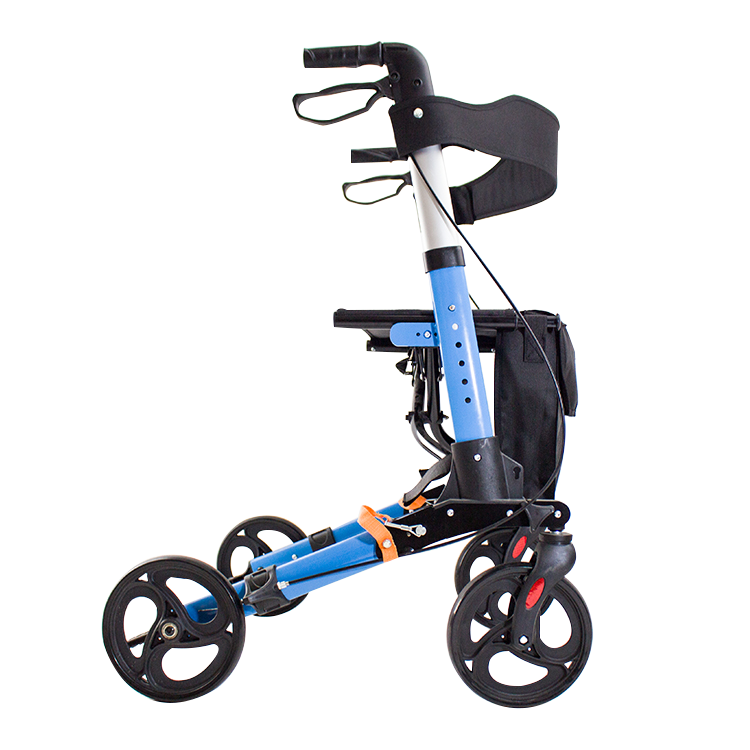
Marketing materials frequently emphasize extreme portability. However, you must verify weight versus stability independently. Weigh the physical sample yourself using a calibrated digital scale. Do not rely solely on the printed brochure metrics. Ensure a lightweight aluminum rollator walker foldable walking model retains required structural rigidity. It needs a balanced mass to maintain a safe center of gravity. If the frame feels exceptionally light, the user risks tipping over backward on slight inclines.
Test the folding mechanism efficacy rigorously. Execute a one-handed folding operation multiple times. Compare the mechanics of a cross-brace fold against a standard A-frame fold. Assess the frame for dangerous pinch points. Fingers easily get caught in poorly designed hinges during the unfolding sequence. Check if the unit stands independently when folded. Self-standing models prevent the user from bending down to retrieve a fallen device.
Conduct a realistic transit simulation. Follow these steps to mimic real-world usage:
This routine verifies ergonomic handling for caregivers and elderly users alike. If the device feels awkward or overly wide when collapsed, daily transport becomes a major frustration.
Braking systems represent the most critical safety component of any mobility device. Conduct exhaustive loop-lock brake tests. Squeeze the handles aggressively. Ensure the internal cables route cleanly through the aluminum frame. If they sit externally, they must fasten securely to prevent snagging on furniture. Loose cables create severe tripping hazards in residential environments. Test the parking brake function on a controlled incline. Engage the locks and place significant weight on the seat. The brakes must hold the maximum stated user weight completely. Watch closely for any micro wheel slippage.
Perform rigorous seat and backrest load testing. Inspect the seat material closely. Nylon offers decent flexibility, while padded PVC provides better moisture resistance. Check the underlying stitching for obvious tear risks. Apply dynamic, repeated pressure to the backrest strap or hinge. This action mimics a tired user dropping heavily into the seat. The backrest anchors must withstand this sudden impact without bending or snapping.
Look for regulatory compliance and certifications on the physical sample. A trustworthy rollator walker will display required regulatory markings directly on the frame labeling. Verify the presence of FDA, CE, or ISO 13485 badges. These indicators validate the manufacturer's internal safety claims. They prove the factory follows strict international medical device protocols.
Common Mistake: Treating the parking brake test as an afterthought. Many units stop well while rolling forward but fail entirely to hold the user safely in place when seated on a minor slope.
The sample experience reveals crucial details about the manufacturer's operational maturity. Start by evaluating the packaging and assembly process. Examine the exterior shipping materials closely. Did the sample arrive damaged or scratched? Good suppliers use reinforced corner protectors and dense foam inserts. Test the tool-free assembly instructions. The required sequence should feel intuitive for a layperson. Ensure the instruction manuals read clearly and contain accurate, visually compliant diagrams.
Check the physical sample for parts availability and modularity. Wear-and-tear components degrade predictably over time. Handgrips wear down, and wheels lose tread. Determine if the unit uses proprietary fittings. Proprietary parts force you to rely entirely on the original manufacturer for years. Standard, easily replaceable hardware drastically simplifies maintenance for clinical fleets.
Use this evaluation period to test the rollator walker supplier directly. Monitor their communication responsiveness to technical inquiries. Ask them to clarify specific load-bearing tolerances. Request documentation detailing warranty coverage for structural frame defects. Prompt, detailed answers indicate a highly reliable partner. Vague responses signal future communication breakdowns.
Best Practice: Request an exploded-view diagram of the unit alongside the physical sample. This diagram proves the manufacturer documents every single screw, bearing, and washer, guaranteeing reliable future parts availability.
Comparing physical mobility samples serves as an essential exercise in risk mitigation. A rigorous, hands-on evaluation of frame integrity, usability, and safety components protects everyone involved. It keeps the end-user safe from preventable injuries and painful falls. It also shields your business reputation from the severe fallout of distributing poor-quality clinical inventory. Never compromise on your physical testing standards based on visually appealing brochures.
Take immediate action based on your comprehensive evaluation data. First, shortlist the specific models passing both your dynamic load tests and folding ergonomic checks. Next, request a small-batch pilot order for the winning unit. This pilot phase allows you to monitor real-world adoption and gather authentic end-user feedback. Finally, finalize the warranty terms and replacement part agreements with your chosen manufacturer. Proactive negotiation ensures a smooth, highly reliable product rollout.
A: Focus closely on brake cable tension loss and wheel bearing degradation. These specific issues frequently appear after simulated outdoor use. Poorly designed cables stretch over time, significantly reducing stopping power. Cheap bearings gather dirt quickly, causing the wheels to lock up entirely or drag unevenly across flat surfaces.
A: Check the provided documentation for independent third-party lab testing certifications. Do not rely on internal factory claims alone. Physically apply a dynamic load using sandbags or equivalent weights during your test. Place this load squarely on the seat and press down on the handles heavily to test overall frame stability.
A: Outdoor models feature much larger wheels ranging from 8 to 10 inches. They utilize superior tread materials like polyurethane or rubber for enhanced shock absorption. Additionally, outdoor units feature heavier, vibration-dampening frames. Compact indoor models use smaller wheels and prioritize narrow frame widths for navigating tight residential doorways.
A: Cross-brace designs fold side-to-side effortlessly. This smart mechanism allows the unit to stand upright independently when collapsed. It also lets users navigate very narrow doorways while the device remains partially folded. This superior functionality makes cross-brace models generally better for highly active users who travel frequently.


