Professional Wheelchair & Mobility Aids Manufacturer | Feiyang Medical Phone: +86-13809226584 E-mail: fymed@vip.163.com

Author: Site Editor Publish Time: 2026-09-30 Origin: Site
Procuring manual mobility equipment requires meticulously balancing clinical demand against supply chain efficiency. Purchasing managers constantly juggle the need for diverse sizes while managing strict factory requirements. Miscalculating the distribution of a crucial metric like wheelchair seat width can severely tie up capital in slow-moving bariatric models or cause frustrating stockouts of standard sizes. For B2B buyers, distributors, and healthcare facilities, forecasting the exact ratio of standard to specialized widths directly dictates Minimum Order Quantities (MOQ) and production lead times. This guide breaks down how to strategically plan your purchasing cycles and properly evaluate manufacturing limitations. You will discover practical methods to optimize your container mixes without ever compromising patient care or operational cash flow.
Demand Distribution: Standard 18-inch and 20-inch widths typically account for 70-80% of procurement volume, dictating baseline MOQ planning.
Mixed-Container Strategies: Reliable suppliers allow MOQ to be split across a specific wheelchair series, helping buyers stock bariatric or narrow sizes without buying full dedicated batches.
Manufacturing Realities: Wider seats (22"+) require structural reinforcements, extending standard 30-day lead times by an additional 10-15 days due to custom tooling.
Supplier Evaluation: The right manufacturing partner provides transparent forecasting models, flexible SKU mixing, and verifiable safety compliance for non-standard frames.
Understanding user demographics is the first step in successful procurement. The industry considers the 18-inch seat the absolute baseline. It comfortably accommodates the average adult user, making it the highest-volume item in almost every inventory. However, clinical demand rarely sticks to averages. You must account for pediatric users needing 14-inch to 16-inch models, alongside bariatric users requiring 22-inch to 24-inch configurations. These extreme ends of the spectrum consistently skew purchasing timelines because factories do not mass-produce them at the same aggressive pace.
To accurately forecast your purchasing needs, you must analyze your historical data. Examining past orders helps you align seat dimensions and weight capacities to define your core purchasing ratios. When reviewing your wheelchair seat width specifications, follow these precise auditing steps:
Extract 12-month historical data: Pull sales or clinical issuance records from the past year. Group items strictly by seat width.
Identify seasonal or regional spikes: Notice if certain facilities or regions order higher percentages of heavy-duty models.
Cross-reference weight capacities: Ensure wide frames correspond correctly to higher weight limit requests. A wide seat on a standard frame poses severe safety risks.
Define the 80/20 ratio: Determine which standard sizes make up the bulk of your orders, isolating the remaining niche sizes for customized MOQ planning.
Holding dead stock represents a massive financial drain. Overstocking niche sizes often happens when buyers order factory minimums of rarely used models without a confirmed sales pipeline. This ties up warehouse space and damages return on investment. You must avoid ordering a full container of 24-inch models simply to hit a manufacturer's quota. Instead, precision forecasting ensures you only buy what your specific market actively absorbs.
Best Practice: Always maintain a rolling three-month forecast based on clinical intake data rather than purely relying on past sales, as demographic needs can shift quickly.
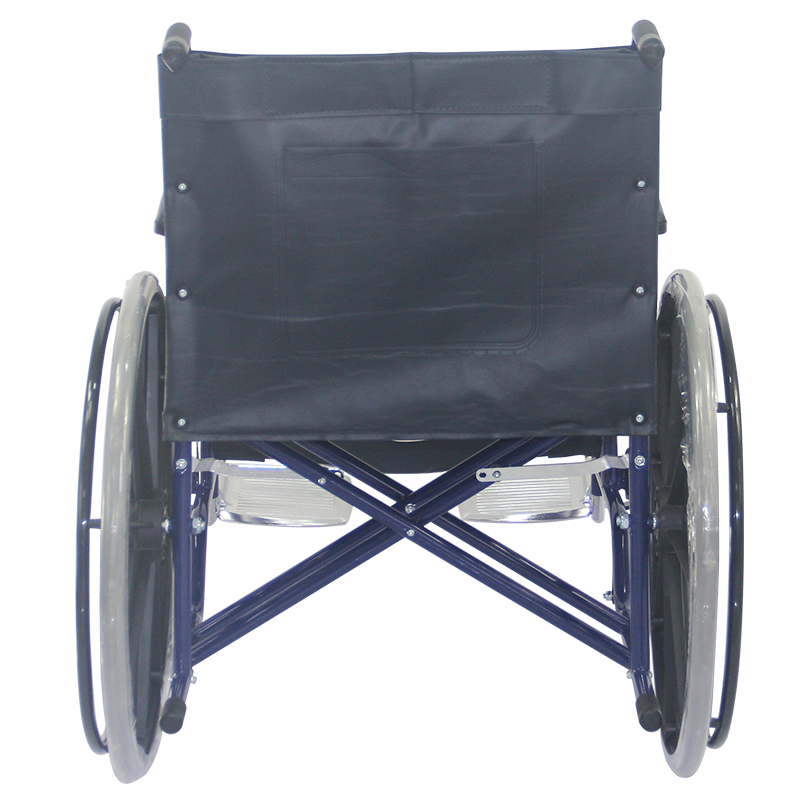
Manufacturers impose strict Minimum Order Quantities per size for very logical production reasons. We call this the batch production constraint. Different frame widths require entirely different welding jigs. Workers must cut raw materials to distinct lengths, recalibrate assembly line machinery, and adjust quality testing rigs. Switching tooling from an 18-inch run to a 22-inch run costs the factory time and labor. They pass these setup costs down to the buyer via strict MOQs.
Smart buyers navigate this constraint through skilled negotiation. The most effective strategy involves structuring your purchase order across a unified wheelchair series. By consolidating your request under one product family, factories can share identical components like armrests, footplates, and wheels across different widths. This allows you to combine 16-inch, 18-inch, and 20-inch models into a single 20-foot or 40-foot high-cube (HQ) container. The factory still hits its overarching volume targets, and you avoid over-purchasing slow-moving items.
Furthermore, evaluating tiered pricing models helps optimize your spend. Bulking up your standard sizes can effectively subsidize the higher unit cost of low-MOQ bariatric models. When negotiating, you present a large volume for standard units as leverage. You ask the supplier to waive the strict MOQ on the wider models in exchange for the large core order.
Sample Mixed Container Strategy (40ft HQ Capacity: ~300 Units)
Seat Width | Target Audience | Container Allocation (%) | Estimated Unit Count |
|---|---|---|---|
16-inch | Pediatric / Small Adult | 10% | 30 Units |
18-inch | Standard Adult | 60% | 180 Units |
20-inch | Wide Adult | 20% | 60 Units |
22-inch+ | Bariatric | 10% | 30 Units |
Common Mistake: Failing to confirm if the manufacturer allows sub-minimums within a mixed container. Always get written confirmation that a 30-unit batch of 22-inch chairs will not trigger a surcharge.
Production timelines vary dramatically based on the dimensions you request. Standard sizes usually ship within a reliable 30-to-45-day window. Manufacturers achieve this rapid turnaround because they pre-stock raw materials for 18-inch and 20-inch configurations. They keep their assembly lines running continuously for these units. Since these models represent the highest global demand, suppliers treat them as priority outputs.
Wide configurations introduce significant bottlenecks. You must factor in delays for bariatric models, which often add an extra two to three weeks to the manufacturing cycle. Custom widths require bespoke upholstery cutting. Engineers must recalculate specific axle placements to ensure the user does not tip backward. Center-of-gravity testing takes longer because the physics of a wider chair differ significantly from standard models. Factories rarely stockpile oversized upholstery or specialized crossbraces, meaning they only source these raw materials after you place the order.
To mitigate these delays, you must implement aggressive buffer stock strategies. Formulating accurate reorder points (ROP) for non-standard items prevents disastrous stockouts. You calculate the ROP by multiplying your average daily usage rate by the extended lead time in days, then adding your safety stock. Using historical lead-time data ensures you never leave a bariatric patient waiting months for critical equipment during unexpected transit delays.
Standard Frame Lead Time: Typically 30–45 days (pre-tooled, readily available raw materials).
Bariatric Frame Lead Time: Typically 45–60+ days (custom upholstery, custom tooling, reinforced testing).
Transit Buffer: Always add 10–14 days to your ROP to account for port congestion or customs clearance holds.
Procurement teams sometimes view a wider seat as just a longer piece of upholstery stretched across the same metal tubes. This assumption proves dangerous. A wider seat requires a fundamentally stronger frame to prevent lateral collapse. When user weight shifts in a 24-inch chair, the torque applied to the folding mechanism multiplies significantly. To support higher weight capacities—typically ranging from 300 to 500-plus pounds—the chair demands superior structural integrity.
This is precisely why bariatric models mandate the integration of a heavy duty double cross bar steel chassis. A single crossbrace will inevitably bend under excessive load. Dual crossbars distribute the user's weight evenly across the entire lower frame, preventing the wheels from bowing inward. Upgrading to heavy-duty steel ensures the chair survives rigorous daily use in demanding healthcare environments.
These reinforced materials create a noticeable supply chain impact. Specialized steel grades cost more to procure. Reinforced welding processes take longer to execute and require highly skilled technicians. Because of this, the final unit cost rises, and the raw-material sourcing timeline extends. Recognizing these engineering demands helps you justify the higher price points and longer wait times to your stakeholders.
Chart: Standard vs. Bariatric Engineering Requirements
Component | Standard Model (18") | Bariatric Model (22"+) | Supply Chain Impact |
|---|---|---|---|
Crossbrace System | Single aluminum/steel | Double heavy-duty steel | Increases MOQ requirements for custom metal cutting. |
Upholstery Tension | Standard nylon | Reinforced, double-stitched | Requires specialized textile sourcing, extending lead times. |
Axle Placement | Fixed standard position | Rearward adjusted | Necessitates custom engineering sign-offs per batch. |
Weight Capacity | Up to 250 lbs | 350 lbs - 500+ lbs | Mandates rigorous secondary ISO testing before shipment. |
Your supply chain is only as robust as the manufacturing partner anchoring it. Assessing a wheelchair seat width supplier requires looking far beyond unit pricing. You must evaluate their operational flexibility and communication transparency. A top-tier factory willingly accommodates mixed-width container loads. They openly report production delays rather than hiding them until the scheduled ship date. Strong communication channels allow you to adjust your domestic inventory planning in real time.
Quality control protocols serve as your next major evaluation checkpoint. You must verify the supplier tests every single width configuration for structural stability. Some factories only send their standard 18-inch models out for ISO 7176 compliance testing. They incorrectly assume the wider variants will pass by default. You need documented proof that the 24-inch bariatric model passed static, impact, and fatigue tests under its stated maximum weight limit.
Finally, mitigate your procurement risk by instituting a strict trial order policy. Never commit to container-volume MOQs for a new supplier without first auditing physical samples. Request sample units representing the extreme ends of the size spectrum—such as the 16-inch pediatric and the 24-inch heavy-duty versions. Inspecting these outliers reveals the true manufacturing capability of the factory, ensuring they handle complex, non-standard engineering just as well as high-volume runs.
Planning MOQ and lead times for varying seat dimensions remains an essential exercise in supply chain agility. By mapping out a highly accurate ratio of standard to bariatric sizes, you eliminate wasted warehouse space and free up critical budget. Leveraging a unified product series to blend MOQs allows you to source specialized sizes without committing to unrealistic production minimums. Furthermore, accounting for the complex engineering of wider frames ensures your delivery timelines remain realistic and reliable.
To implement these strategies immediately, start by initiating a detailed inventory audit of your last four quarters. Identify exactly which configurations sit idle and which frequently face stockouts. Next, request a mixed-container production forecast from your shortlisted manufacturing partners to test their flexibility. By taking these proactive steps, you guarantee a steady flow of essential mobility equipment customized perfectly to your demographic needs.
A: Most credible B2B manufacturers allow width mixing within the same wheelchair series to reach container minimums, though they may require a sub-minimum (e.g., 50 units) per specific width.
A: Wider chairs require reinforced materials (like double crossbars), distinct tooling jigs, and specialized upholstery. Manufacturers rarely keep these custom components pre-assembled in high volumes.
A: A safe baseline for adult populations is roughly 10% narrow (16"), 60% standard (18"), 20% wide (20"), and 10% bariatric (22"+). Adjust this based on specific demographic health data or institutional focus.
A: Not necessarily, but it shifts the product into a different production category. If the heavy-duty frame uses distinct raw materials, the factory may enforce a strict MOQ to justify the machine setup costs.


